
A Story Woven Across Generations
A personal connection with woven art, developed through study, workshop practice and teaching, now shaped into a broader vision for Persian textile arts.
Where the Thread Began
My relationship with woven art began in childhood, in the cold climate of Azerbaijan, where woolen kilims and colorful tribal carpets were part of everyday life. Beside my mother, I became familiar with threads, textures and the rhythm of weaving. At the time, education came first, and this interest remained quietly stored away for years.
Nearly three decades later, that childhood connection returned. I began studying textile and handicraft techniques professionally, received formal training, opened a small workshop and started teaching others who shared the same passion. Over time, the workshop grew into an educational space and a handicraft business.
IKAT grows from that journey. Our vision is larger than one product or one region. We want to help preserve the warmth, character and human energy of Persian textile arts while presenting them in a way that belongs naturally in contemporary homes and international markets.
By bringing ancient craftsmanship together with modern color, proportion and design, we hope to create a meaningful bridge between Persian heritage and the world.
IKAT — A Name Carried Through Generations
The Story of IKAT
IKAT — a lasting name set, in our family telling, against Iran’s 7,000-year cultural history. The story describes an ancient craft that, at one moment in memory, served not only beauty and textile-making but also resistance.
In the oral account passed down through the founder’s family, the name IKAT is explained as carrying ideas of possession or wealth and of patterning cloth with metallic thread. The makers remembered as Ikat makers were said to possess the skill to draw metals such as steel, gold and silver into thread and to weave richly patterned gold-woven and silver-woven textiles.
The same story tells of special carpet-like textiles woven from steel fibres and silk through a particular technique. They were said to be able to remain in flight for up to four minutes at their highest point. In modern terms, the family compares their form to a wingsuit: archers could launch from high cliffs and fortresses such as Babak Castle or Alamut, travel through the air and fire at enemies from a distance. The narrative connects this tactic with long periods of resistance associated with Hassan Sabbah and Babak Khorramdin. To those who witnessed it, the account says, the sight was so extraordinary that enemies believed demons had taken flight.
According to the family story, after the strongholds were conquered, orders were given to kill the Ikat makers and destroy the flying carpet-kites.
What followed is the part of the story that became a family symbol. The relatives of those who had died are said to have held a ritual of remembrance. Using cloth or silk-woven kilims, they recreated the lost carpet form as diamond-shaped kites and sent them into the sky. Rings were added to the tails, with each ring marking another year since the death of a loved one. The custom is remembered as especially meaningful among survivors and defenders connected with Alamut and Babak, where the kite became a symbol of resistance, grief and remembrance.
During the rest of the year, these kites were hung on walls. The story says that when the Abbasid authorities ordered the symbols to be collected in an effort to erase their memory, families adapted them once again. Esfand (wild rue), a plant traditionally valued in Iranian homes, was threaded beneath small diamond-shaped woven pieces in place of the kite-tail rings. In this new form, the memorial could remain on the wall while also serving as a familiar protective symbol against the evil eye.
For the founder, this is not only a distant legend. Her grandmother preserved the stories of Babak Castle and kept one of these esfand hangings on the earthen wall of her home in memory of their Ikat-maker ancestors. Later, her mother hung the same kind of symbol in the family carpet-weaving workshop.
Today, the diamond form has returned to the loom. A new IKAT kilim is being dyed and woven with the motif at its centre, intended to become a signature of the brand — a contemporary textile carrying forward a family memory of craft, resistance, loss and remembrance.
Your Partner for Authentic Persian Textile Arts
Your Partner for Authentic Persian Textile Arts
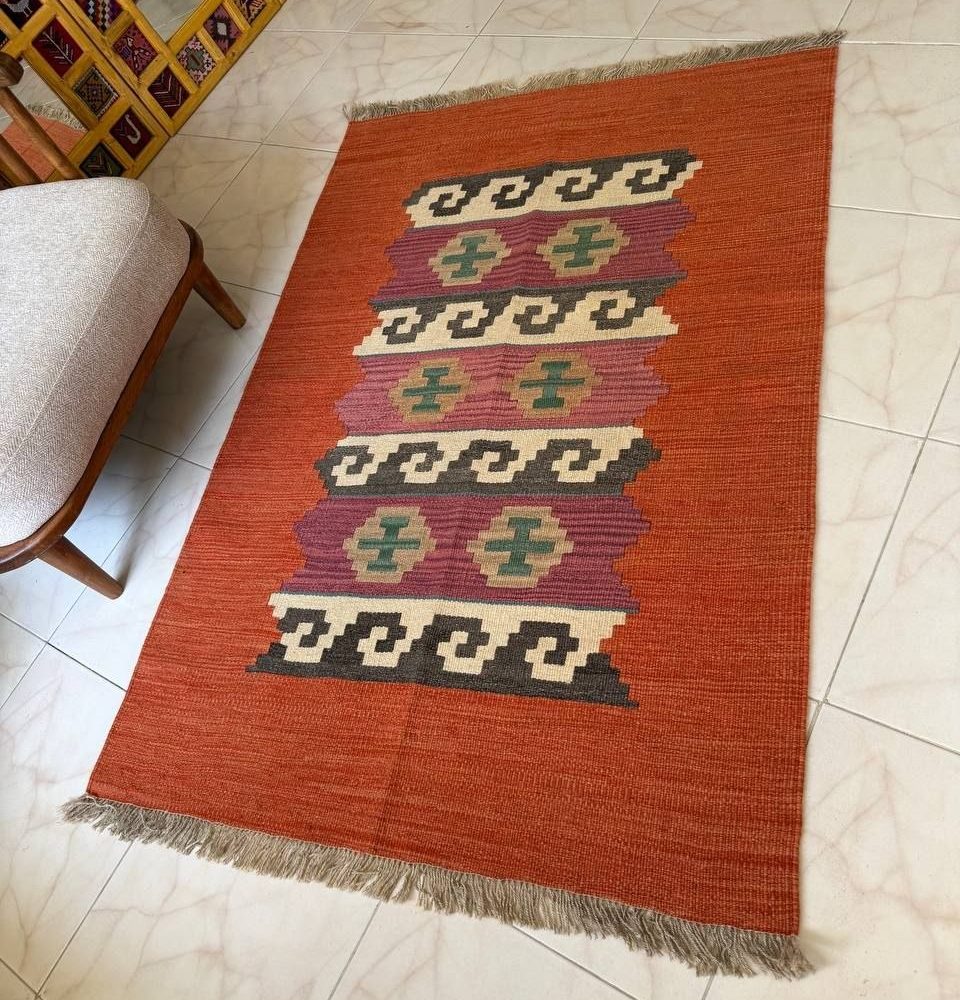
IKAT is an Iran-based textile and handicraft brand focused on introducing authentic Persian woven arts to international buyers. We work with handmade kilims today, while building a broader platform for textiles, fabrics, embroidery, rugs, carpets and related craft traditions.
For us, export is not simply the movement of products from one country to another. It is an opportunity to present the knowledge, materials, stories and workmanship behind every piece with clarity and respect.
Closer to the Craft
Where possible, we work directly with skilled makers and production partners from textile-producing regions of Iran. This gives us better visibility over materials, workmanship, finishing and consistency while creating a more transparent relationship between craft and buyer.
Specific sourcing regions are published only after client confirmation.
Clear Review Before Delivery
Before an item is prepared for delivery, it can be reviewed for overall finish, construction, color condition, fiber integrity and order specifications. Export packaging can then be selected according to the product type and destination.
Laboratory or certification claims are shown only when supporting documentation is available.
Training, Qualifications & Professional Development
IKAT has grown through practical experience, formal learning and continued engagement with textile and handicraft techniques. Selected certificates and qualifications are presented below.