
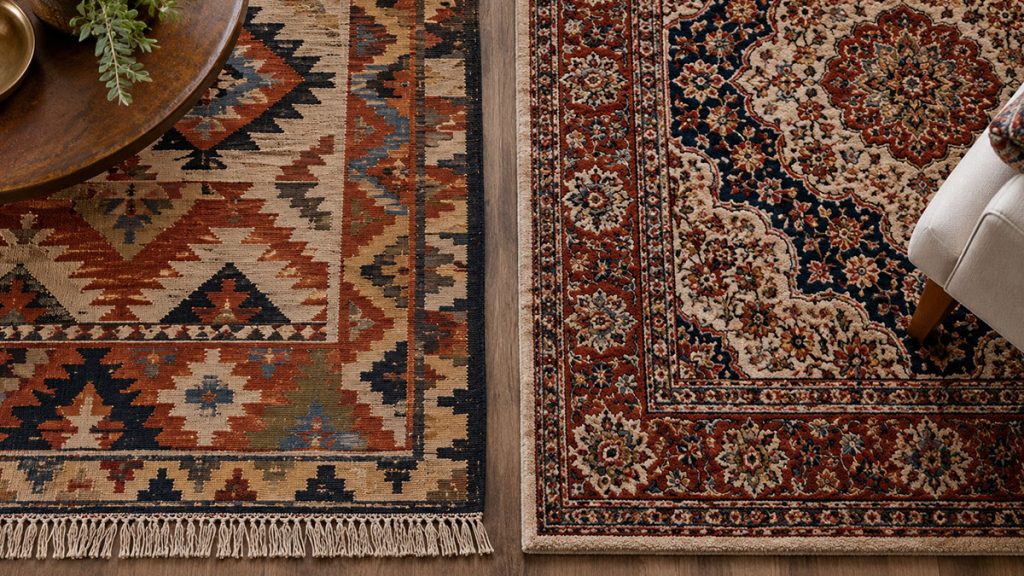
When choosing a traditional floor covering, international buyers often ask an important question: What is the difference between a kilim and a carpet?
Although both are woven textiles used for flooring and decoration, their construction, texture, weight, appearance, and production methods are different.
Understanding these differences can help buyers choose the right product for retail, interior design, wholesale, or personal use.
What Is a Kilim?
A kilim is a flat-woven textile made by interweaving warp and weft threads.
Unlike traditional pile carpets, kilims do not have knots or a raised surface. Their structure is relatively thin, flexible, and lightweight.
Handwoven kilims are commonly made from materials such as:
- Wool
- Cotton
- Natural fibers
- Traditional or natural dyes
Many Persian kilims feature geometric patterns, tribal motifs, and regional designs that reflect the weaving traditions of different parts of Iran.
What Is a Carpet?
A traditional carpet is usually made using a knotted pile construction.
During production, individual knots are tied around the foundation threads and then trimmed to create a soft, raised surface.
This technique gives carpets their characteristic thickness and texture.
Persian carpets are especially known for their detailed patterns, fine craftsmanship, and high knot density.
Kilim vs. Carpet: The Main Differences
The biggest difference between a kilim and a carpet is the weaving method.
1. Weaving Technique
Kilims are created using a flat-weaving technique.
Carpets are generally produced by tying thousands of individual knots onto a woven foundation.
Because no pile is created in a kilim, the finished textile is much flatter.
2. Thickness
Kilims are usually thin and lightweight.
Carpets are thicker because of their pile structure.
This difference can affect transportation, storage, cleaning, and how the product is used in an interior space.
3. Weight
A kilim is generally lighter than a carpet of similar dimensions.
For international buyers and importers, this can sometimes make kilims easier to handle, fold, package, and transport.
4. Texture
Kilims have a relatively flat surface where the woven structure can often be clearly seen.
Carpets usually have a softer and more cushioned texture because of their pile.
5. Design
Both kilims and carpets can feature traditional Persian designs, but their visual styles are often different.
Kilims frequently use:
- Geometric forms
- Diamonds
- Zigzag patterns
- Tribal symbols
- Repeated motifs
- Bold color combinations
Traditional Persian carpets can include more detailed floral patterns, medallions, borders, and highly intricate designs.
Which Is Better for Modern Interiors?
There is no single answer because kilims and carpets serve different purposes.
Kilims work particularly well in spaces where buyers want a lighter and more natural textile appearance.
They are commonly used in:
- Minimalist interiors
- Contemporary homes
- Rustic spaces
- Bohemian interiors
- Traditional decoration
- Boutique hotels
- Interior design projects
Their relatively thin construction also makes them suitable for layering with other rugs.
Carpets are often preferred when softness, warmth, and a heavier decorative presence are important.
Are Kilims Easier to Transport?
In many cases, yes.
Because kilims are thinner and lighter than traditional pile carpets, they can usually be folded or rolled more compactly.
This can be useful for international buyers, retailers, and wholesalers who need to consider packaging and shipping requirements.
However, packaging should still protect the textile from moisture, dirt, and excessive pressure during transportation.
Are Kilims Handmade?
Traditional Persian kilims are commonly handwoven.
The production process may require significant time and skill, particularly when complex patterns or natural materials are involved.
Because handmade textiles are created individually, small variations in pattern, dimensions, and color may appear from one piece to another.
These variations are often considered part of the authenticity and character of handmade kilims.
Which One Should International Buyers Choose?
The right choice depends on the intended market and use.
A kilim may be more suitable when buyers are looking for:
- Lightweight handmade textiles
- Traditional geometric designs
- Easy-to-display decorative products
- Natural wool products
- Flexible interior accessories
A traditional carpet may be more appropriate when buyers want:
- A thicker floor covering
- Soft texture
- Detailed decorative patterns
- Higher pile
- A more formal interior appearance
For wholesalers and retailers, offering both categories can also provide customers with a wider range of choices.
Persian Kilims for International Buyers
At IKAT, we introduce selected handmade Persian textiles to international buyers looking for authentic Iranian craftsmanship.
Our kilim collection focuses on traditional designs, quality materials, handmade production, and the distinctive identity of Iranian weaving.
Buyers can contact IKAT for information about available designs, materials, dimensions, packaging, and export inquiries.
Frequently Asked Questions
Is a kilim the same as a rug?
A kilim is a type of flat-woven rug. However, not every rug is a kilim because rugs can be produced using many different weaving and knotting techniques.
Is a kilim thinner than a carpet?
Yes. Kilims generally have no pile, making them thinner and lighter than traditional knotted carpets.
Are Persian kilims made from wool?
Many traditional Persian kilims are woven from wool, although cotton and combinations of different fibers may also be used.
Can kilims be used on the floor?
Yes. Kilims are widely used as floor coverings, but they can also be used as wall decor, furniture coverings, and decorative textiles.
Are kilims suitable for export?
Yes. Their relatively lightweight and flexible construction can make handmade kilims attractive products for retailers, wholesalers, interior designers, and international buyers.